Canonical by construction
Formatting, comments, definition order and bound-variable names converge on one normalised semantic representation.
implemented AXEPH0.1
Source
One canonical semantic source for people, IDEs, CI systems and autonomous agents—designed to produce deterministic programs with identities anyone can verify.
; functions · bindings · explicit host effect
(module
  (def discounted
    (fn (subtotal)
      (if (> subtotal 1000)
        (- subtotal (/ subtotal 10))
        subtotal)))
  (def main
(print (discounted 1788))))ax11e7df900fdd…cda10be01 canonical semantics
02 machine-first truth
03 explicit effects
04 verifiable identity
Axeph begins with identity, effects and verification—the things conventional toolchains often bolt on after the language has already accumulated ambiguity.
Formatting, comments, definition order and bound-variable names converge on one normalised semantic representation.
implementedAlpha-normalised AXB1 bytes are hashed with BLAKE3. Modules receive stable ax1… identities.
The current print effect crosses an explicit Host boundary. Full inferred effect rows and runtime capabilities are next.
Stable codes, UTF-8 source spans and machine-applicable repairs make the checker useful to people and automated systems.
implementedThe local store writes, retrieves and re-verifies modules by semantic hash. Networked dependency resolution remains roadmap work.
local store shippedThe interpreter is live today. AxIR, WASM, native and web backends will share the canonical semantic source.
roadmapThe compiler pipeline keeps textual concerns at the edge. Canonical identity, checking and execution all work from the same AST.
Read the architecture notesThe CLI never maintains a second interpretation of the language. Canon, hash, check and run all call the same Rust core.
$ axc canon examples/pipeline.axeph
(module (def discounted …) (def receipt …) (def main …))
$ axc hash examples/pipeline.axeph
ax11e7df900fdd31…
$ axc check examples/pipeline.axeph
✓ well-formed
$ axc run examples/pipeline.axeph
Axeph Foundry / total AUD 1610
{
  "severity": "error",
  "code": "AX0002",
  "message": "unbound variable 'prirnt'",
  "span": { "line": 4, "column": 21 },
  "fixes": [{
    "with_var": "print"
  }]
}Agents do not scrape terminal prose. They receive the same structured evidence an IDE uses, then can apply a bounded repair and check again.
Real Axeph language support: semantic highlighting, located diagnostics, execution, canonicalisation and content identity.
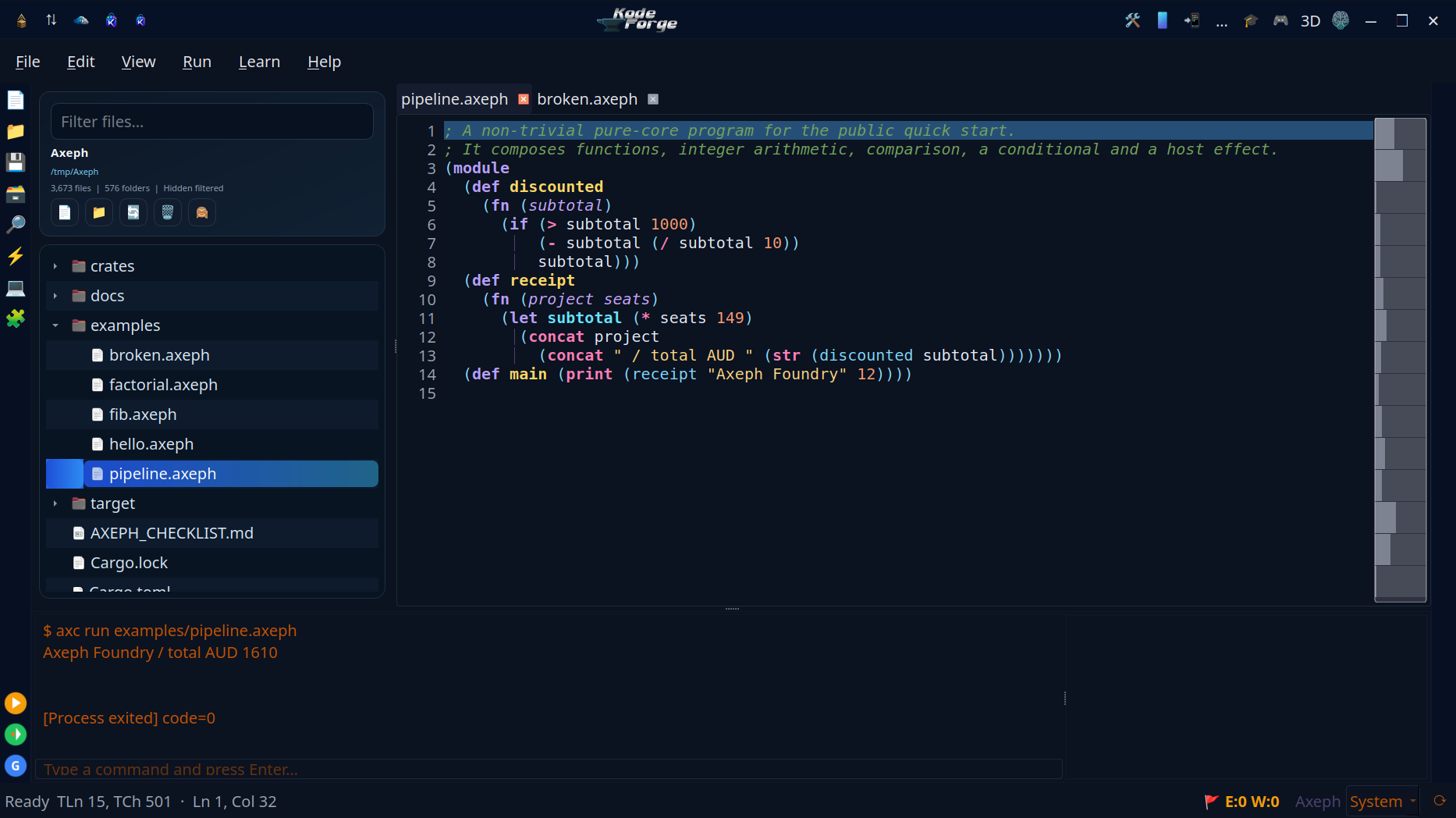
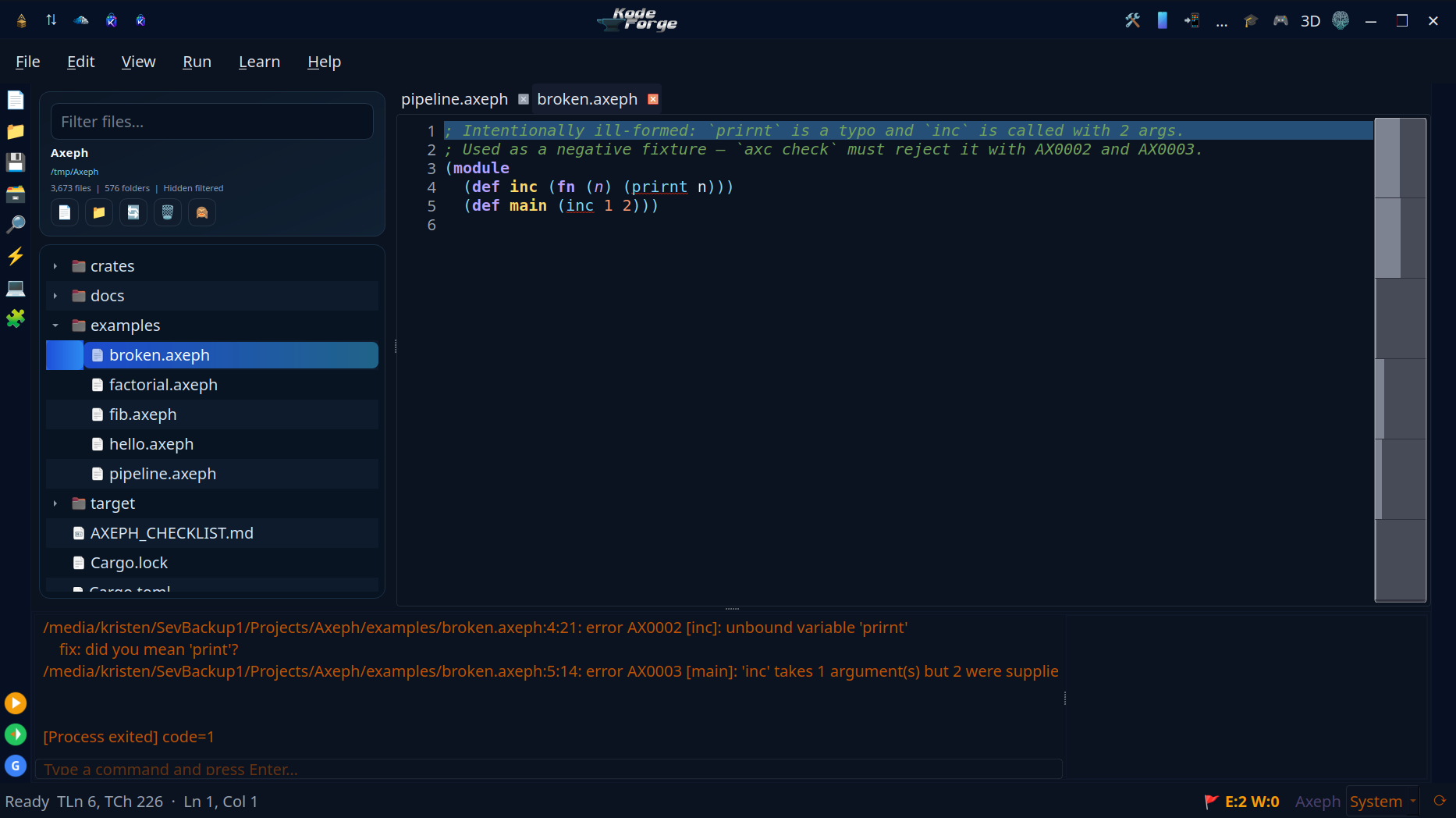
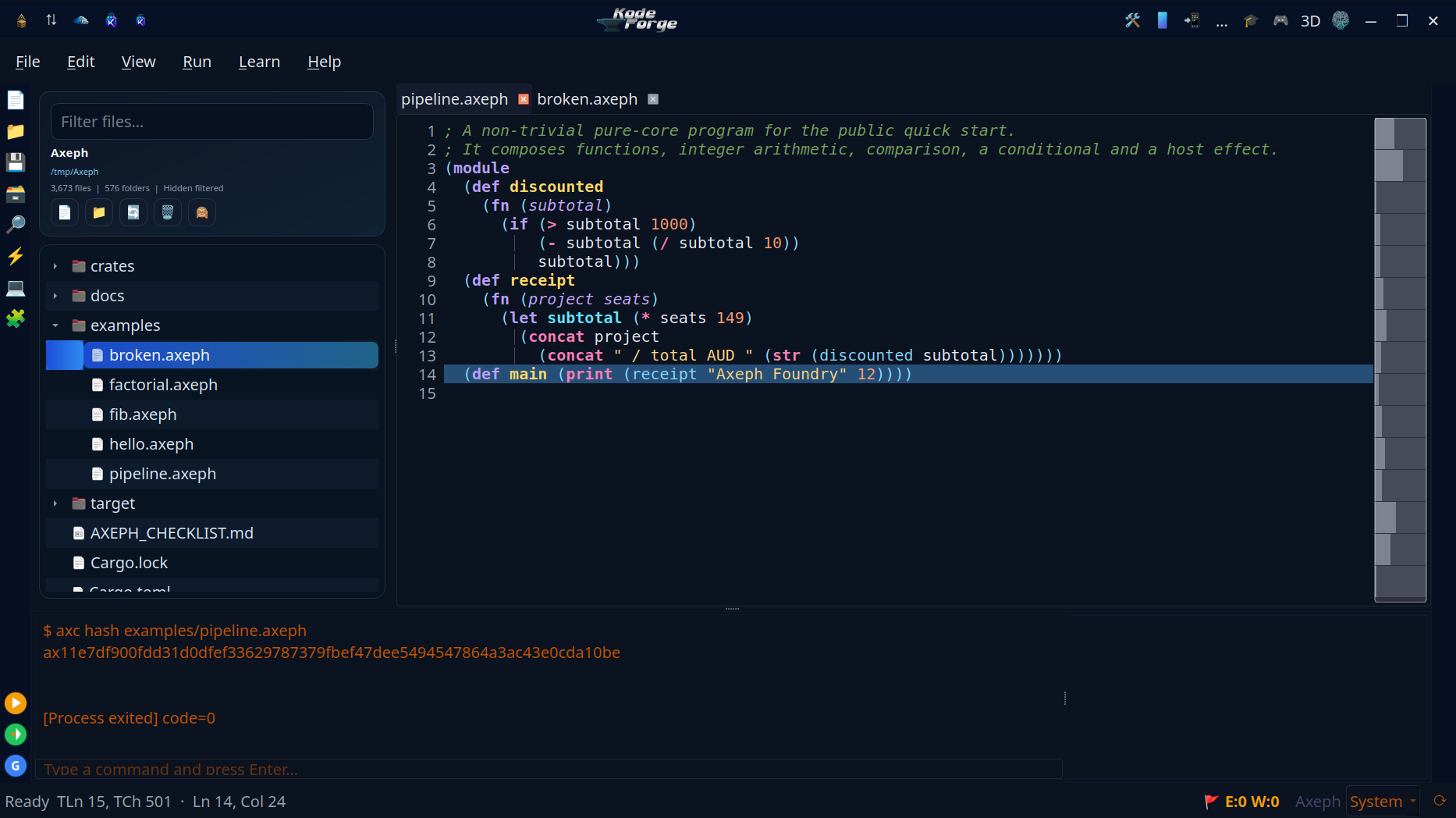
Clear boundary: these screenshots demonstrate Axeph integration with KodeForge. KodeForge itself is proprietary and is not part of the open-source Axeph distribution.
Seven focused components make the current language easy to inspect, test and evolve.
axirAST, reader, canonical writer, AXB1, normalisation, hash, checker and evaluator.
coreaxrtExplicit runtime hosts for real and captured output.
runtimeaxcCanonicalise, hash, binary, check and run from one driver.
cliaxeph-playInteractive REPL and fast file evaluation loop.
replaxeph-checkMachine-first JSON checker for IDE, CI and agent consumers.
verifyaxpmLocal semantic-hash object store with integrity verification.
storeaxeph-studioNative dogfooding workbench built directly on axir.
ideThe complete language and toolchain source is public under Apache License 2.0. KodeForge is not included.
$ # Synchronise or download Axeph from KodeCryptX
$ cd Axeph
$ cargo build --workspace
$ cargo test --workspace --all-targets
$ ./target/debug/axc run examples/hello.axephAxeph 0.1 proves its semantic substrate through runnable artifacts. Roadmap claims do not graduate until their test gate is green.
Reader · canonical form · AXB1 · BLAKE3 · goldens
gate greenClosures · recursion · checked primitives · REPL
gate greenScope and arity shipped; inference and capability checks next
in progressAxIR · WASM · native · contracts · package registry
roadmapAXEPH